


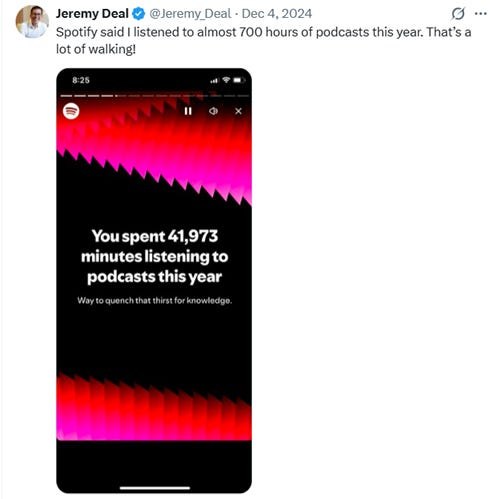
Like many intellectually curious people, I’ve listened to hundreds of hours of podcasts. By comparison to some (see pic below), I’m still an amateur.
Over time, though, my opinion of podcasts has changed.
Most podcasts are entertainment.
Even the best ones rarely change your life on their own. Instead, they introduce you to an idea. If you’re lucky, that idea becomes a spark. The real value comes from what you do after you stop listening.
Many of the habits that have meaningfully improved my life including exercise routines, productivity systems, nutrition, even how I think about health can all be traced back to a podcast. But none of those improvements came from simply following advice I heard during a conversation. They came from reading books, digging into research, experimenting, and refining over months or years.
The podcast was merely the invitation.
Which brings me to my favorite podcast.
It isn’t my favorite because it contains the greatest collection of ideas. There are countless podcasts that are more tactical or more information-dense.
It’s my favorite because of how it makes me feel.
In 2019, Tim Ferriss interviewed Jim Collins. I’ve listened to hundreds of podcasts since then, yet this conversation continues to surface in my mind. When Tim recently interviewed Collins again, discussing his newest book What to Make of a Life, I realized why.
It’s Jim Collins himself.
The Joy of the Work

I’m already a fan of Collins’ writing. I find myself speaking in “Collins language” all the time when discussing companies.
Good to Great is one of the most influential business books ever written. Here’s a short thought experiment to prove it:
Take the idea of the flywheel.
How many businesses actually possess a flywheel - a business that becomes stronger with every customer, where each sale feeds the system ultimately making acquiring the next customer easier?
Now ask a different question.
How many companies claim to have a flywheel?
That’s the mark of a truly influential book. Its vocabulary becomes part of the jargon of business, even when the underlying ideas are often misunderstood or, more often, misrepresented.
But that’s not why I return to the podcast.
What has stayed with me isn’t a framework or a mental model.
It’s Collins’ enthusiasm.
Listening to him makes you want to sit down and do meaningful work.
Not because you’re chasing money.
Not because you’re chasing status.
Simply because the work itself is deeply worthwhile.
That feeling is surprisingly rare.
Most conversations about work revolve around climbing, achievement, promotions, compensation, exits, or recognition. Collins seems almost uninterested in those things. His curiosity feels intellectually pure. He studies companies because he genuinely wants to understand excellence.
That passion is contagious.
He also makes aging feel exciting.
Rather than treating your later years as a slow decline, Collins argues, with ample anecdotal evidence, that many people produce their best work during the final quarter of their lives.
That’s an incredibly optimistic idea.
Success itself can become dangerous if it causes you to stop pursuing meaningful work. Money isn’t the objective; it’s simply a resource that gives you the freedom to pursue work worth doing (A very Charlie Munger-esque idea).
What Makes a Good Day?
One idea from the podcast has stayed with me for years.
What makes a good day?
Great days are easy to identify. Closing a deal. Receiving a promotion. Launching a business. Those moments are memorable precisely because they’re rare.
But what makes an ordinary Tuesday meaningful?
Collins offers three remarkably simple answers:
Simplicity.
Spending long stretches in a state of flow.
Being with people you genuinely care about.
I find myself revisiting this recipe regularly. It’s easy to fall into worry traps, where the concerns of the day outweigh the ability to focus on deeper work. The formula above provides a course correction out of the worry trap.
1% IRR
There are podcasts with better advice.
There are podcasts with more famous guests.
There are podcasts with bigger ideas.
This remains my favorite because every time I finish listening, I want to take off my airpods and get back to meaningful work.
If a podcast can consistently produce that feeling, it’s probably worth revisiting.
I hope it does the same for you.