



January is a natural time for refresh and reflection. Throughout the year, there’s no shortage of books, essays (Substacks, of course) and missives to read, podcasts to digest, lectures to watch, and the never-ending news cycle (!).
My belief is that the most important lessons aren’t new. They’re timeless.
Many of today’s meaningful ideas trace back to the Founding Fathers, the Enlightenment, the Romans, the Greeks and Eastern Philosophy. Human nature hasn’t changed much. Incentives haven’t changed. Fear, greed, patience, discipline, and compounding behave the same way they always have.
The point is that every learning cycle doesn’t need to stretch toward something new, but rather to reinforce the lessons that already work.
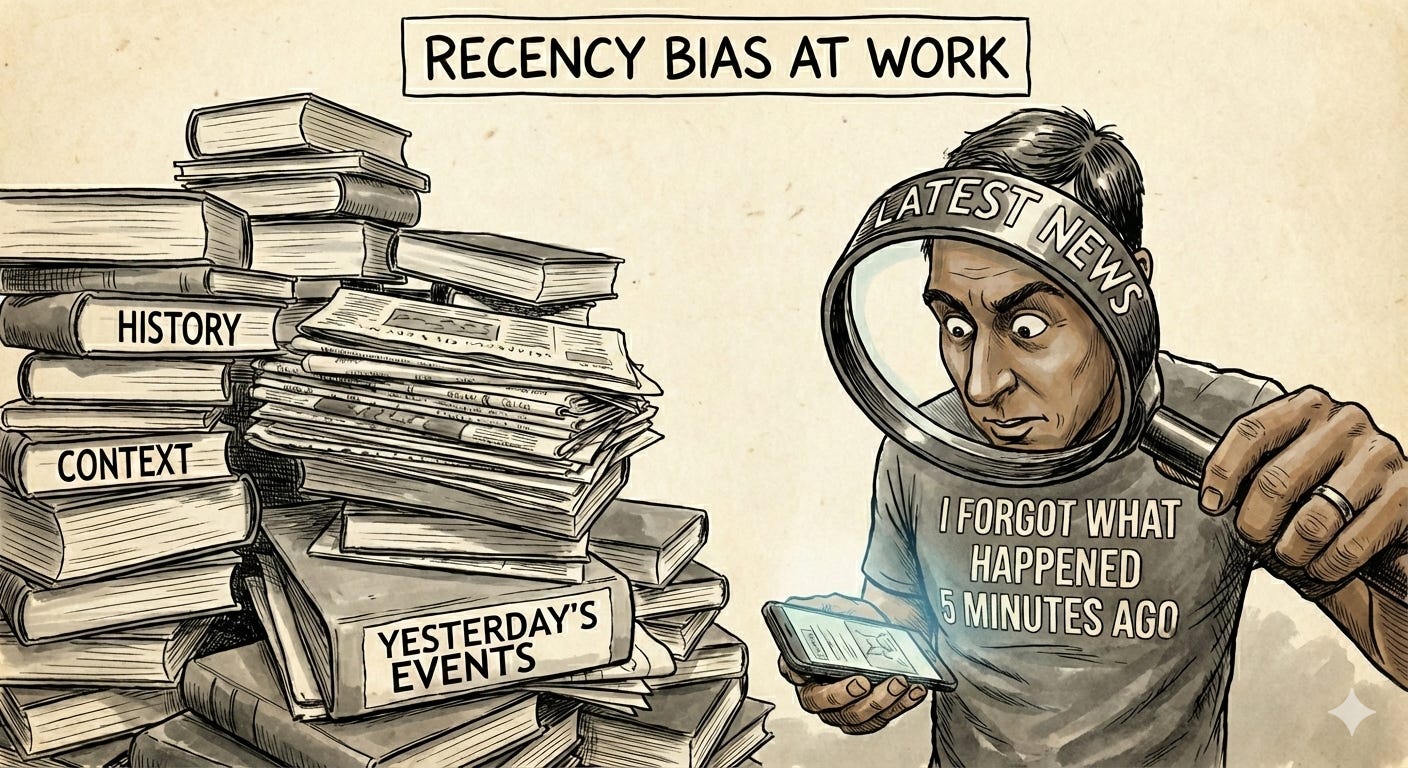
I have a particularly strong form of recency bias. I tend to run on the track of the most recent lesson learned - the last lesson, book, idea, or market move that felt insightful. But, my sense is that the discipline to stick with fundamentals is where the richest learning actually lives.
Steph Curry is said to take 300 - 500 shots after every practice. The work doesn’t stop because the performance was good. The work continues because that’s what makes the performance inevitable.
That’s how I think about January - not as a month to chase novelty, but as a time to keep taking practice shots. My typical default is to look for the new: the book that unlocks the breakthrough, the novel idea that leads to a multi-bagger, the person that opens the door, the ultimate hack or nugget of new information. But that misses the point. Timeless lessons, reinforced, are often far more powerful than new ones discovered.
January Plan
The goal isn’t volume. I don’t want this to feel like homework. Instead, it’s the equivalent of gym time (where all of the audio portions will be consumed). I want a digestible list that strengthens the core muscles, doesn’t lead to overwhelm and is ENERGY-PRODUCING. One where you get up with a spark.
The lesson itself is only part of it. An equally important part is re-infusing back into the subconscious making lessons recent, available, and usable when it matters.
So here is my Annual Discipline Reinforcement list.
Habits, Systems & Compounding
James Clear — Any long-form podcast on habits
You don’t rise to goals; you fall to systems. He seems to be everywhere in January, so this one is easy to find.David Allen — Getting Things Done
”Your mind is for having ideas, not holding them”He’s also on numerous podcasts. A good annual reminder to clear open loops and create mental space to focus on what matters.
Health-Span
Peter Attia – Outlive Notes
His recent AMA on cardio-respiratory training covered many of the main concepts. I also have a copious notes on Outlive.
On a related note, DEXA Scan and VO2 Max planned for month-end.
Work, Craft & Long-Term Output
Paul Graham — “How to Do Great Work”
Obsession plus patience compounds. “Develop a habit of working on your own projects.” is a line that resonates.Paul Graham — “Maker’s Schedule, Manager’s Schedule”
Protect deep work; it’s where real progress lives.For the productivity nerds: I find that deep work reduces stress levels. It’s incredibly easy to slip into Manager mode. A recurring reminder to myself: if possible, deep work first, then Manager mode. Not easy, but worth strengthening the muscle.
Business, Leverage & Alignment
Kevin Kelly — “1,000 True Fans”
You don’t need to be the most popular person, just trust and alignment with people who appreciate the work.Naval Ravikant — “How to Get Rich Without Getting Lucky”
One of many, many lessons: Play iterated games. All the returns in life, whether in wealth, relationships, or knowledge, come from compound interest.
Investing, Risk & Decision-Making
Warren Buffett — The Superinvestors of Graham-and-Doddsville
Temperament matters more than IQ.Charles D. Ellis — The Loser’s Game
Winning is mostly about avoiding unforced errors.“Even God Would Get Fired as an Active Investor”
Short-term underperformance is often the price of long-term edge.
Meaning, Temperament & the Inner Scorecard
Viktor Frankl — Man’s Search for Meaning (Audio Book - Simon Vance)
Part 1 is a stark reminder of the possibilities of human nature, both terrifying and inspiring. We can only hope to learn vicariously (and NOT experientially) from this…I have found Simon Vance’s reading to be particularly impactful.David Foster Wallace — “This Is Water”
”Morning boys, how’s the water?”Tuning Fork Analogy
I was introduced to this by a coach/counselor that I worked with this past year. It has resonated with me. Here is a random blog on the concept that I enjoyed.
Learning & Thinking Clearly
Charlie Munger — “A Lesson on Elementary, Worldly Wisdom”
Annual Reminder: You have to have mental models in your head.Annie Duke — “Risk Shmisk”
The real risk: Doubling down on a losing strategy and blaming the losses on bad luck. A lesson which can be widely applied beyond investing (and poker).
The Intended Result but Unintended Outcome
This is my attempt to focus on the fundamentals until they feel obvious again.
The list isn’t about discovering something clever. It’s about reinforcing what works -just like Steph Curry getting shots up after the lights go out.
However, even thus far in the list, I digest the lessons differently that in years past. None of the words change, but I have changed…So, I see things differently.
Hopefully, this list helps…just 1%…everyday...
Please reach out directly if you have anything to add.
Great piece here, Donnie, thank you!
So much "value" lies latent in increasing our attention back over to what we "already know," and shifting our intention out of the "getting more" attainment zone of external grasping and over to the "going deeper" attunement zone of inner alignment.
One of my favorite ways of thinking about various approaches to skill development is to look through the frames of Dabbler, Obsessive, Hacker, and Mastery.
Much in line with your piece, the path of Mastery requires ongoing reflection and engagements with "the basics" (such as Steph's shooting drills) to widen and strengthen the foundations upon which greater growth ultimately depends. The Mastery path is not only marked by focused intention and attention, but also by appreciating that while it may be less exciting and dynamic, the compounding power of time, effort, and focus is inestimable.
I appreciate your contribution here in shifting our gaze up to value that winning the long game is a key ingredient for staying meaningfully involved in playing the infinite game.