


This is the first post in a multi-part series. The intention is to track growth with AI tools such as Claude Cowork. Hopefully, I will look back at this and think - how basic!
There’s a particular kind of low-grade stress that rarely makes it into the self-help canon. It’s not the deadline panic, the career anxiety, or the leadership pressure. It’s quieter — the constant background hum of wondering if you’re missing something. When I think of the sources of ambient angst — doomscrolling news cycles, glued to stock prices, worries about kids, family, health, diet, exercise, life — the one that underlies all of them is missing an important task.
I think it’s a natural progression to take on more as we grow into the prime of our lives. In my case, my to-do lists have evolved from solely focusing on career progression. They now include numerous businesses, ventures, projects like co-chairing VALUE Cville (an investing society), hosting a podcast, writing this Substack, and, importantly, family / kids, health, trip planning, and all the other life tasks.
Whether through scope creep or by design, each one lived in its own file. Each one required its own attention. When hyper-focused on one, a small part of me wondered if I was missing something.
In short, I wasn’t drowning in tasks. I was drowning in friction.
The Cost of Fragmentation
Here’s what I have learned about productivity systems: they don’t fail because you stop caring. They fail because they become taxing to maintain. Time, attention, mental energy — every file you have to open, ensure is updated and cross-reference is a small tax. Having five to-do files is five taxes. Multiply that by every day of the week, and you have a real overhead problem.
David Allen, whose Getting Things Done framework I’ve followed for years, talks about the brain as a bad office. It was not designed to hold your to-do list. It was designed to do the work. Every piece of information you store up there, an open loop in GTD parlance, that could live somewhere else is a CPU cycle you’re wasting.
I knew this intellectually. I just hadn’t fully solved it.
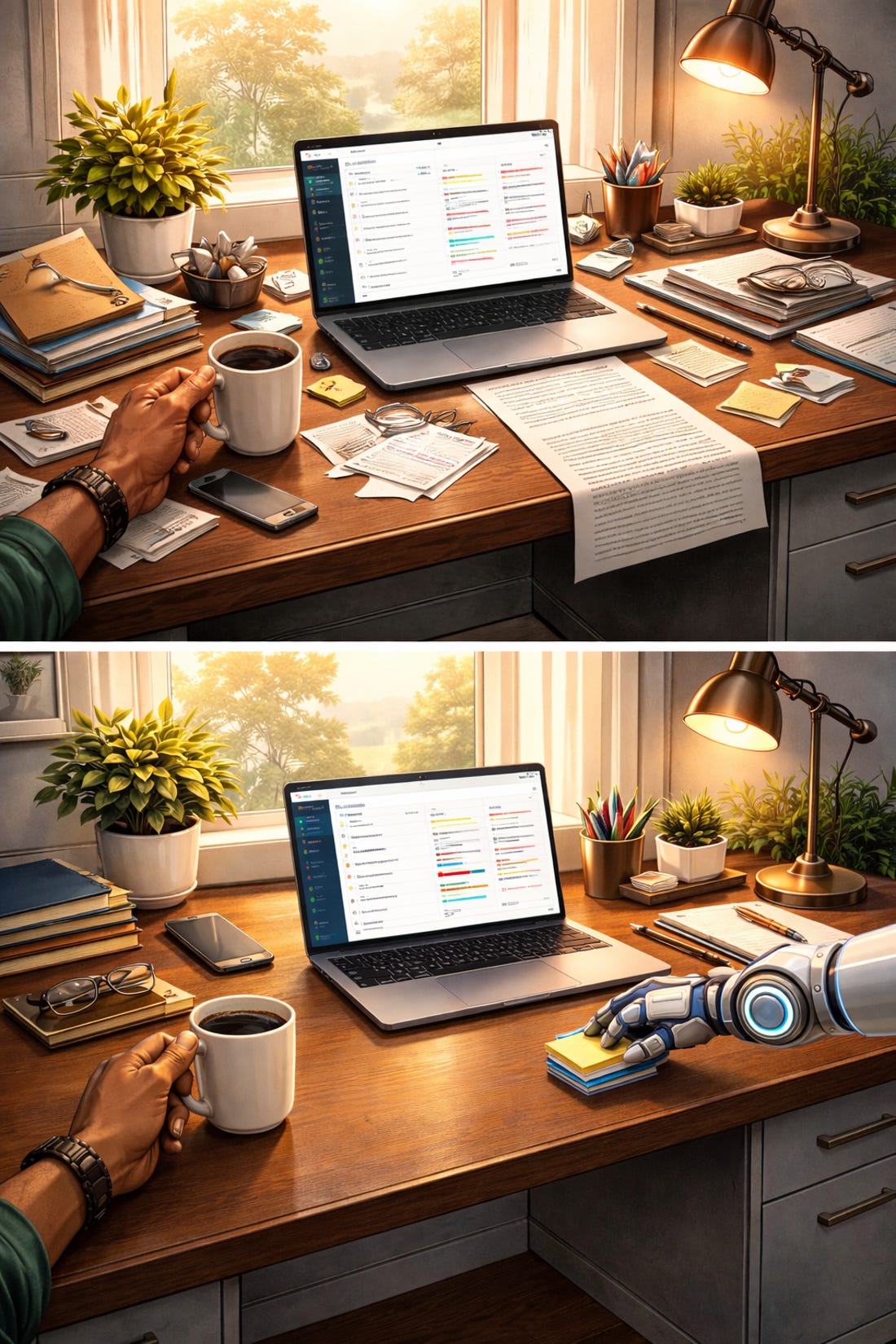
The Experiment
A couple of weeks ago I started using Claude Cowork — Anthropic’s desktop AI tool that lets you give Claude access to files on your computer. I’d been curious about Claude Code but felt intimidated since I have no coding background. However, once Claude Cowork was announced, I figured I should jump in but wasn’t sure where to start. Turns out I started exactly where I needed to: the thing causing me the most low-grade pain.
I copied all of my to-do list files into a single folder. (Worth noting: I made a copy, not a move. This is advice I received from a seasoned coder. It’s good protocol whenever you’re letting any AI iterate on your files — keep a safety net.) Then I gave Claude access to that folder and asked it to build me a master tracker: one unified dashboard with all my projects organized by status.
What came back surprised me. Not because it was magic. Because of the elegant simplicity in having a single Master Tracker which was encoded with a system I could build on.
A separate section for ideas — which, if you know GTD, you know capture is the whole game. One file. Every project. Clear status for each item: in progress, done, waiting. The system I’d been meaning to build for years, assembled in minutes.
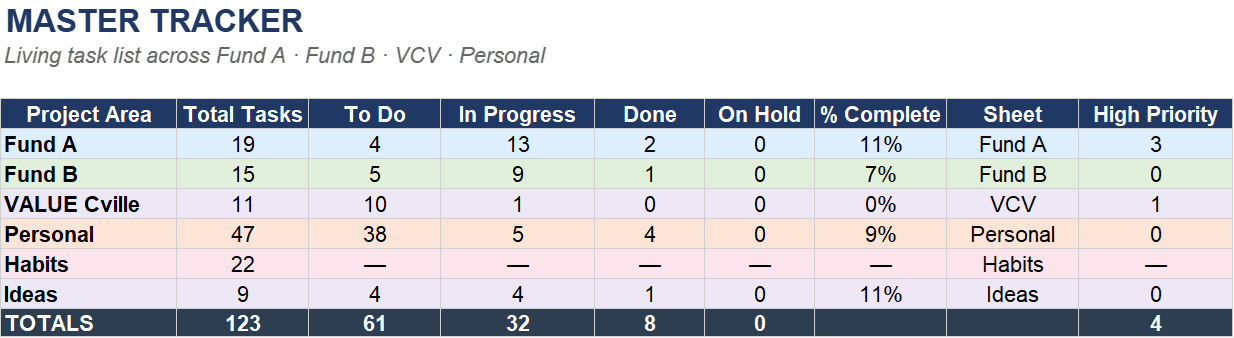
Generic version of the Dashboard
The Lifting of Ambient Angst
A quick side story. I used to get bad back spasms, most likely from improper weight-lifting techniques. One bad spasm required a doctor’s visit as OTC meds were not working. The doctor prescribed a strong muscle relaxer. After a few days, I decided the grogginess was no longer worth it. Near my gym, was a chiropractor. I had tried a chiropractor maybe once or twice but didn’t really know if there was any effect.
However, this chiropractor cracked my back in a way that immediately lifted the back spasm. It was the oddest moment of relief — one minute, feeling a knot in the back and the next, it being completely gone.
That is how I felt about Cowork’s Master Tracker — an immediate lifting of a source of discomfort.
What It Actually Feels Like
The experience of using it is almost boring to describe, which I think is the point.
I open the tracker. I scan the projects. I move things to “done.” I ask Claude to clear out the completed items. I close the file.
I send Claude new items via chat as they come up.
That’s it.
There’s no shuffling between five windows. No half-remembered task that was in the “other” list. No wondering. The ambient angst associated with to-do list overwhelm — that low-level hum — has waned. I’d put it at a 50% reduction, which is not nothing when you consider that the noise never fully went away when I had five lists.
Claude has offered to do more. It keeps asking if I want daily prioritization, end-of-day summaries, recommendations on what to tackle next. I’ve declined — not because I don’t think it could be useful, but because I want to walk before I run. I’ve over-automated too early before (Outlook email folders!) and lost trust in the system. For now, simple is working.
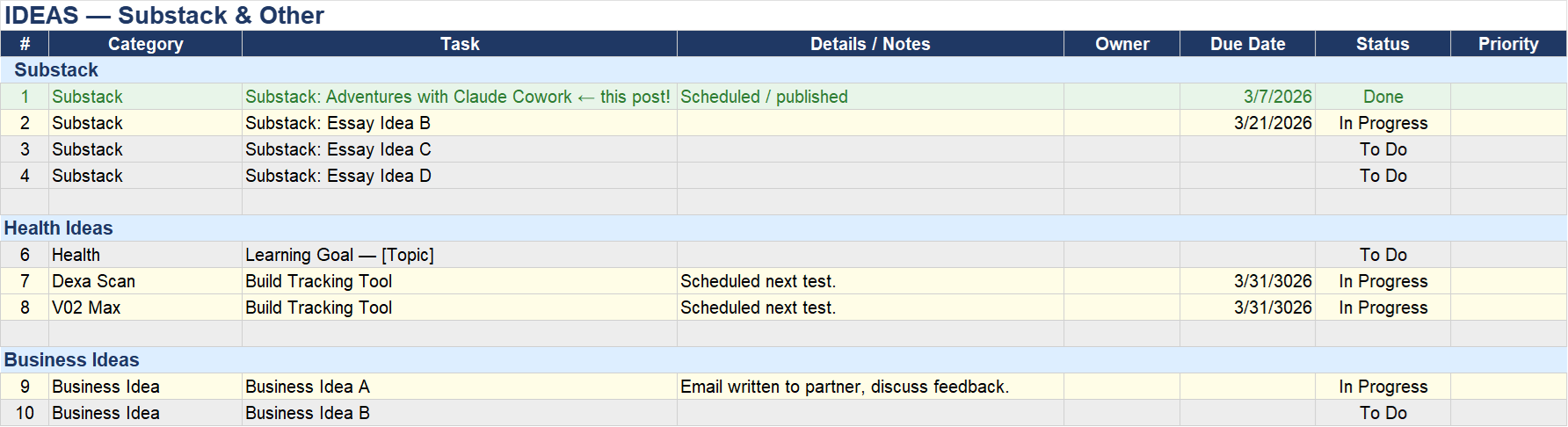
Generic version of an Ideas page.
Where I’m Watching Next
A few things are on my radar. Claude connects to Notion, which I use heavily as an everyday tool. That integration could be another inflection point — though I’m aware that adding complexity before the current system is fully stable would be a mistake. One step at a time.
I’m also curious about what happens when I start querying the tracker more conversationally — asking Claude what’s mission critical, what’s been sitting too long, what I should be prioritizing. That feels like the next natural evolution. But I’m not there yet.
For a brief window, I’m sitting with what I have. One tracker. One place to look. One less reason for the background hum to run.
Some improvements are dramatic. This one was just quiet.