


I noticed several unfinished drafts sitting in my folder recently. After spending some time diagnosing the problem, I realized many of them stemmed from the same issue: knowing when to use an LLM, and, equally as important, when not to.
Inputs vs. Outputs
Whether you’re researching a new market, building a presentation, constructing a financial model, navigating legal or accounting questions, planning a trip, or creating a household budget, there is little doubt that LLMs are a powerful addition to the workflow.
Take research as an example. The process usually begins by climbing the learning curve: gathering information, identifying key players, understanding the landscape, and gradually developing a thesis. Eventually, the findings need to be communicated and acted upon.
LLMs can assist at nearly every step. They reduce the legwork, accelerate information gathering, and help transform rough ideas into a polished presentation.
At its core, however, the goal is not research. The goal is output.
The output may be an investment decision, a recommendation to take on a new client, a family vacation plan, or figuring out summer camps for your kids (apologies to any parents currently navigating that minefield). Research is merely an input into that final decision.
The challenge is that LLMs can blur the distinction between the two.
When LLMs Confuse
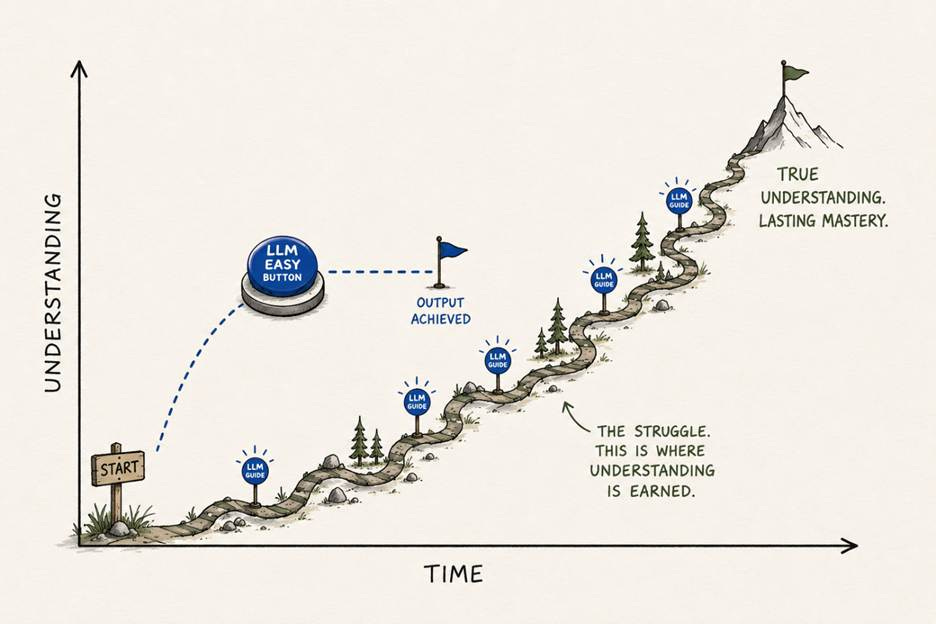
Think back to school. Most people can remember wrestling with a difficult subject. Progress rarely came from reading the perfect explanation once. It came from struggling.
You read, misunderstood, reread, took notes, made mistakes, backtracked, and eventually emerged with a deeper understanding than when you started.
The struggle was the point.
LLMs make it remarkably easy to bypass that phase. With enough prompting, you can often arrive at a finished product without doing much of the work yourself.
The result can be semi-competence without understanding or worse, the illusion of mastery.
Writing as Practice
One belief I hold strongly is that everyone should practice their craft.
Consider Stephen Curry. He can use technology to improve film study, nutrition, recovery, and training efficiency. What he cannot do is outsource the repetitions. Someone else cannot take the shots for him.
The movement patterns, instincts, and recognition only develop through practice.
For me, writing serves the same purpose.
Writing forces me to think clearly. It exposes weak arguments, incomplete ideas, and assumptions I didn’t realize I was making. Most of what I write is simply for myself, though occasionally something feels worth sharing.
The question becomes: when should an LLM enter the process?
As the saying goes:
Easy reading is damn hard writing.
If I hand an unfinished essay to an LLM too early, the topic can begin to drift. The suggestions may be useful, but they can also pull the piece in a different direction. Before long, I am no longer refining my original idea, instead, I am exploring the model’s interpretation of it (in other words, thesis drift).
Additionally, the finished product feels good, but now it’s drifted into territory that I haven’t struggled with.
Investing as Practice
My concern is even greater when I put on my investor hat.
Successful investing often requires understanding the consensus view and determining where your own view differs. Variant perception typically comes from deeper work, broader context, or a longer time horizon than the market is currently applying.
Those insights are rarely found through shortcuts.
Like writing, investing requires working through uncertainty. You gather evidence, challenge assumptions, discard bad ideas, and gradually build conviction.
The final decision, buy, sell, or ignore, cannot be outsourced.
The LLM may sleep well after making the recommendation, but you probably won’t.
Tighten and Brighten
One of the best pieces of advice I received from an editor at my fund was simple:
My job is to tighten and brighten.
The ideas are mine. The structure is mine. The conclusions are mine.
The editor’s role is to improve clarity, sharpen transitions, and remove unnecessary words. Don’t use ten words when one will do.
That is where I think LLMs fit best in many forms of knowledge work.
They can help gather information. They can help pressure-test assumptions. They can help organize thoughts and improve communication.
But they cannot replace the struggle that creates understanding.
That struggle is where conviction is built. It is where differentiated thinking develops. Most importantly, it is where proficiency is earned.
The 1% IRR
LLMs provide an extraordinary “easy button” for many tasks.
The temptation is to use that button for everything.
But when the objective is growth, not merely output, the struggle matters. There is no shortcut around it.
While writing this essay, I came across a term that captures the risk perfectly: cognitive surrender.
Cognitive surrender, as I understand it, is the act of allowing AI to do your thinking for you then accepting its conclusions as your own, whether they are correct or not.
The danger is not that AI makes us less productive.
The danger is that it can make us feel like we have done the work when we have only consumed the result.
And in investing, writing, and most worthwhile pursuits, the value is often created during the work itself.
Great post. Cognitive surrender is something I've been wrestling with as well. This paper (https://papers.ssrn.com/sol3/papers.cfm?abstract_id=6097646) gives some good insight into the issue but is a little light on actionable solutions. Maybe a good Value Cville topic for next year!
Good stuff Donnie! Actual Intelligence vs Artificial Intelligence is certainly a challenging dynamic to master. The question I like to ask is how do we make 1 + 1 = 3?